
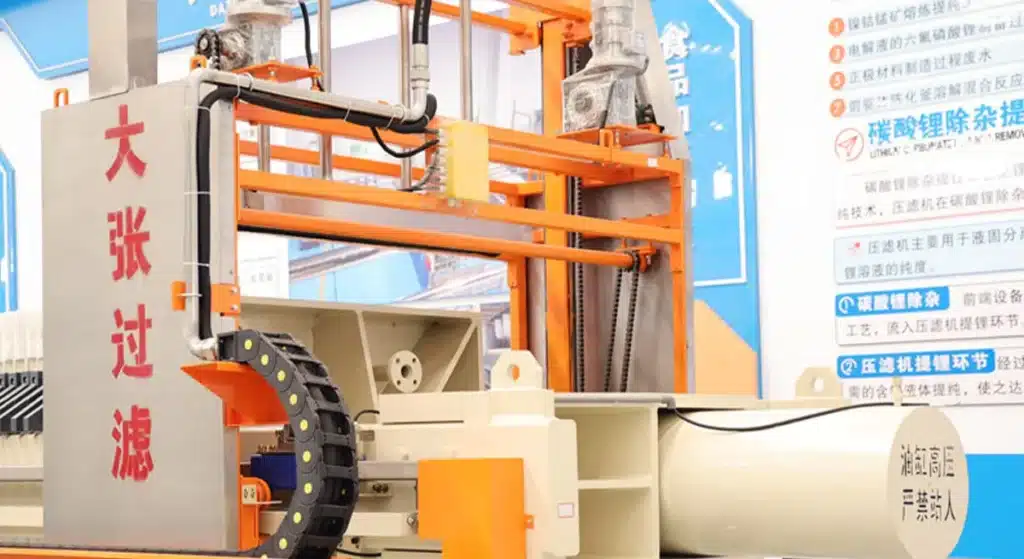
Your filter press choice turns on three numbers: cake moisture, cycle time, and cost per dry ton. A chamber press uses feed-pump pressure only. A membrane press adds a squeeze after the chambers fill. At DZ Environmental we manufacture both program-controlled chamber and automatic membrane filter presses, so the fit should follow your sludge and disposal cost, not a brand preference.
How dry is cake from a chamber versus a membrane press?
A chamber filter press typically discharges municipal or industrial sludge at 25–40% residual moisture. A membrane filter press commonly reaches 18–30% because the diaphragm compresses the formed cake and drives out water pump pressure cannot remove. Gains of 2–5 dry-solids points are typical; mineral sludges often improve more than polymer-conditioned organic sludges.
How much shorter is a membrane cycle?
Membrane squeeze often cuts cycle time by 30–50% versus a chamber press chasing the same dryness. You stop the fill earlier and finish with a short 8–16 bar squeeze. Throughput rises and long-fill cloth blinding drops. In the membrane presses we build, program-controlled pressure profiles keep squeeze even across the pack.
When does membrane capital pay back?
Payback appears when haul, landfill, or dryer cost is priced on wet weight. Each moisture point you remove is water you no longer transport. Higher first cost on membrane plates and squeeze hydraulics is offset by fewer cycles and less downstream drying. A chamber press stays the lower-CAPEX choice when 30–40% cake already meets spec.
Which sludges still favor a chamber press?
Easy mineral slurries, well-conditioned municipal sludge, and plants that already hit dryness without squeeze usually stay on a chamber machine. A Hydraulic Chamber Filter Press or Program-Controlled Chamber Filter Press is simpler and cheaper to cloth. If solids or floc quality swing widely, membrane squeeze is more forgiving of a partial fill.
How do automation and cloth life affect operating cost?
Automatic plate shifting, drip trays, and cloth washing cut labor and hold cycle time steady. Cloth life depends more on weave, polymer dose, and wash frequency than on chamber versus membrane. Our program-controlled machines integrate these functions so fill cutoff and wash sequences stay repeatable.
| Metric | Chamber press | Membrane press |
|---|---|---|
| Typical cake moisture | 25–40% | 18–30% |
| Extra dryness | Baseline | +2–5 dry-solids points |
| Cycle time to target | Longer fill | Often 30–50% shorter |
| First cost | Lower | Higher plates and squeeze |
| Best fit | Stable, easy sludge | Tight moisture or high haul cost |
FAQ
What cake moisture should I specify? Match landfill, incinerator, or dryer limits. Chamber units often land at 25–40%; membrane units at 18–30% on the same sludge.
Does membrane squeeze always cut cycle time? Yes when you stop filling earlier and finish with squeeze. A long fill plus squeeze may not save time.
Is polymer dose different? A well-formed floc still matters. Membrane squeeze cannot fully rescue under-conditioned slurry.
How long do filter cloths last? Months to a year depending on abrasion, pH, and washing. Weave and wash matter more than press type.
Can I retrofit membrane plates into a chamber press? Sometimes, if the frame and closing force were designed for squeeze pressure. Check plate thickness and manifolds first.
What squeeze pressure is typical? Commonly 8–16 bar after a 6–8 bar fill. Excess pressure on a thin cake can damage cloths.