
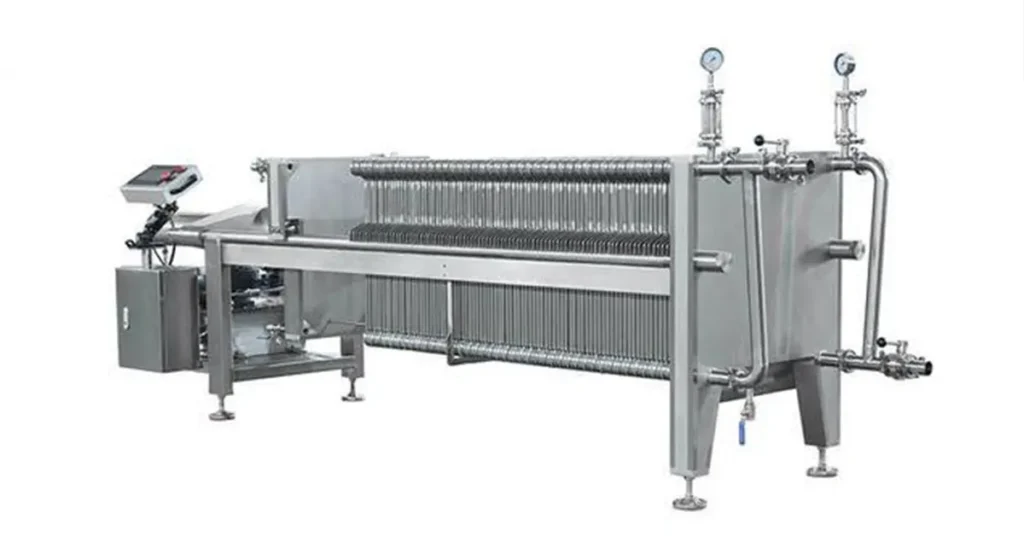
Yes—304 stainless can be enough when process fluids and CIP chemistry stay low in chloride, pH remains mild, and product-contact risk is limited. 316L becomes the safer default when chloride levels rise, acid or chloride-bearing cleaners are used, or fermentation and biopharma campaigns vary. The difference is molybdenum in 316L, which improves pitting resistance. At DZ Environmental we build stainless steel filter presses in both grades when duty allows, with program-controlled chamber and membrane versions matched to fluid and cleaning profile.
When is 304 stainless acceptable?
304 is acceptable for product-contact plates, manifolds, and discharge paths when chloride stays low, cleaning agents are mild, and the stream is not a high-value or highly regulated biopharma intermediate. Mild food streams with neutral pH and limited CIP aggressiveness often fit. Outside the wash-down zone, 304 can also appear on structural parts that never see process fluid. Confirm chloride, temperature, and cleaner list before selecting 304.
When should you specify 316L instead?
Specify 316L when chloride exceeds roughly low-hundreds of ppm, when CIP includes chloride-bearing agents, when acid cleaning is routine, or when campaigns change and fluid chemistry is not fixed. Fermentation broths, biopharma intermediates, and many food streams with variable cleaning fall into this group. Low-carbon 316L also limits sensitization after welding. From the projects we have engineered, 316L is the common choice once chloride or CIP aggressiveness is no longer trivial.
How do 304 and 316L compare on a filter press?
| Factor | 304 stainless | 316L stainless |
|---|---|---|
| Chloride pitting resistance | Moderate | Higher (Mo addition) |
| Typical CIP suitability | Mild cleaners | Chloride / mild acid CIP |
| Weld sensitization risk | Higher if not low-C | Lower (L grade) |
| Relative material cost | Lower | Higher |
| Best fit | Mild, low-chloride duty | Fermentation, biopharma, variable CIP |
Both grades can be finished smooth and drainable. The grade decision is driven by chemistry, not by chamber versus membrane plate type.
Does membrane or chamber design change the grade choice?
No. Product-contact surfaces follow the same fluid rules whether the press is chamber or membrane. Membrane squeeze systems that touch cake or filtrate still need the grade matched to chloride and CIP. A program-controlled automatic membrane filter press improves cycle and wash consistency, but does not allow a weaker alloy on process surfaces.
What data decides between 304 and 316L?
Provide process chloride level, pH, temperature, and CIP agents and concentrations. Note whether campaigns change and whether filtrate or cake returns to product streams. Specify wash-down exposure for the frame so hybrid builds can be evaluated. Our stainless steel filter presses can be supplied in the grade that matches these inputs.
FAQ
Is 304 ever used on biopharma product-contact parts? Rarely. Most biopharma duties default to 316L because CIP and campaign variation raise chloride and cleaning risk.
Can a hybrid press use 304 on the frame and 316L on plates? Yes, when the frame stays outside the wash-down zone and never contacts process fluid or residue.
Does higher alloy improve cake dryness? No. Dryness depends on conditioning, pressure, and membrane squeeze, not on 304 versus 316L.
Is 316 (non-L) acceptable? 316L is preferred for welded hygienic construction because lower carbon reduces sensitization risk.
What is the practical default for variable duty? 316L. It covers a wider chloride and CIP range with less requalification risk when conditions change.