
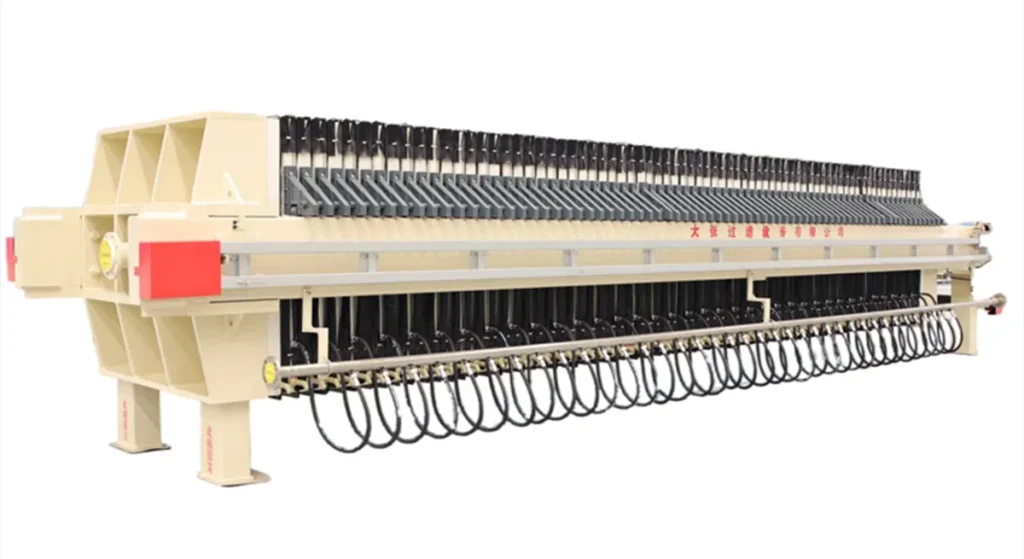
A chamber filter press relies on feed-pump pressure and typically discharges cake at 25–40% moisture. A membrane filter press adds a squeeze after filtration and commonly reaches 18–30% moisture—about 5–12 points drier on the same sludge. Extra dryness cuts disposal weight and drying energy. At DZ Environmental we manufacture both program-controlled chamber and automatic membrane filter presses.
Which press produces drier cake?
A membrane filter press produces drier cake because inflated membranes apply 8–16 bar of squeeze after chambers fill. Chamber plates stop when filtrate flow collapses under 6–8 bar feed pressure. Mineral and lime-conditioned cakes often drop 4–5 moisture points; polymer-conditioned organic sludge usually improves 2–3 points.
How much does lower moisture change operating cost?
Each moisture point removed is water you no longer haul or evaporate. On 20 wet tonnes per day, moving from 35% to 28% moisture removes about 2 tonnes of water daily. Haulage, landfill fees, and dryer energy fall in proportion. Membrane plates cost more than a hydraulic chamber filter press of the same area. From projects we have engineered, payback appears first where disposal is expensive.
When is a chamber filter press the better choice?
Choose a chamber press when sludge drains freely, 30–40% moisture is acceptable, and capital is limited. Coarse mineral slurries often meet spec without squeeze. Our program-controlled chamber filter presses still include automatic plate shifting and PLC interlocks.
What sludge types favor each design?
Match the plate to cake compressibility.
| Sludge type | Chamber moisture | Membrane gain | Preferred |
|---|---|---|---|
| Mineral / lime-conditioned | 28–38% | 4–5 points | Membrane |
| Polymer municipal sludge | 30–40% | 2–3 points | Pilot both |
| Coarse, free-draining | 25–35% | Small | Chamber |
| Fine chemical, compressible | 32–45% | Large | Membrane |
Pilot a few cycles on your actual feed. Cloth weave and polymer dose move results as much as plate type.
How do cycle time and automation affect throughput?
Membrane squeeze often shortens the slow end of the feed phase. Cycle time can drop 15–30% versus a chamber press chasing the same dryness. Program-controlled machines integrate feed cutoff, squeeze, and plate shift. Automatic water washing filter presses we build restore cloth permeability without pulling plates by hand.
What should you specify before you buy?
Specify target cake moisture, daily dry solids, feed solids, and whether cake must be conveyor-stable. Add filtration pressure (typically 0.8–1.6 MPa). In the membrane presses we build, CNC machining and robotic welding keep plate faces flat. Do not size on nameplate area alone; chamber volume, cake thickness (often 30–40 mm), and cycle time set capacity.
FAQ
What cake moisture should I expect from a chamber filter press?
At 6–8 bar feed, expect 25–40% residual moisture when cloth and conditioning are correct.
How much drier is a membrane filter press?
Typically 5–12 points drier, or 18–30% moisture, depending on sludge and squeeze pressure.
Does drier cake always justify a membrane press?
No. If disposal is cheap and 35% moisture is acceptable, a chamber press usually costs less.
Can I convert a chamber press to membrane later?
Only if the frame and hydraulics were designed for squeeze load.
How important is filter cloth compared with plate type?
Cloth weave and blinding often explain more wet-cake issues than plate type.
What pressure do program-controlled DZ presses use?
Typical feed is 0.8–1.6 MPa; squeeze is commonly 1.2–1.6 MPa, set from sludge tests.