
No. Membrane squeeze is a strong dryness driver, but it is not the only one. Final cake moisture depends on polymer conditioning, feed solids, cloth condition, fill pressure, squeeze profile, and air blow. On compressible sludge, optimizing these levers together typically yields larger moisture reductions than raising squeeze pressure alone.
What role does the membrane squeeze play?
The membrane squeeze applies 15–25 bar of uniform pressure after the cake has formed, expelling water that feed-pump pressure alone cannot remove. This is why membrane filter presses usually deliver 2–8 percentage points lower moisture than chamber units on compressible sludge.
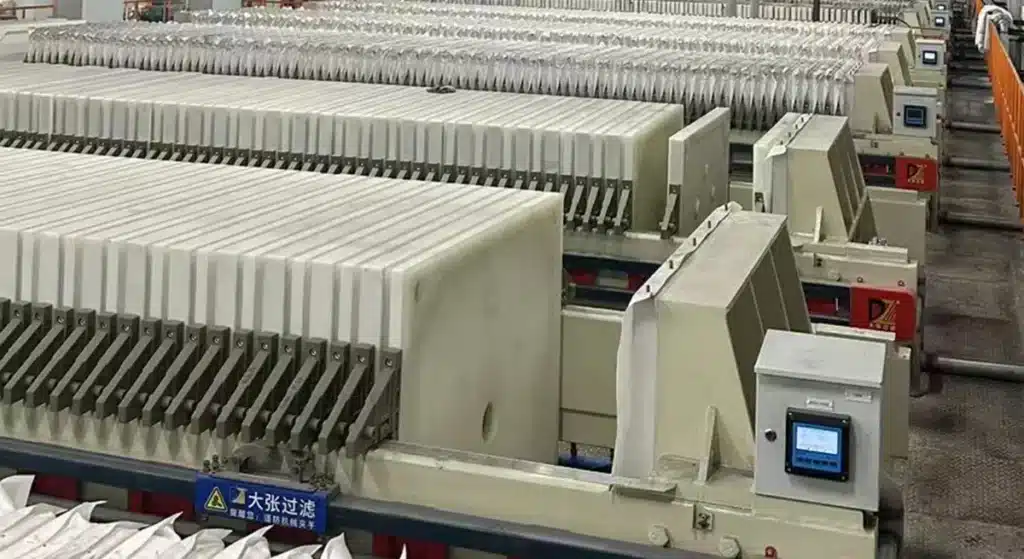
In the membrane presses we build, the squeeze phase is programmed as a controlled pressure ramp so the cake compresses evenly without damaging the diaphragms.
How does polymer conditioning affect final moisture?
Polymer conditioning determines how freely water separates from the solids before filtration begins. Correct dose, type, and mixing create a floc structure that releases free water easily. Under-dosing leaves bound water; over-dosing can blind the cloth.
When conditioning is poor, even high squeeze pressure recovers limited extra dryness. Good conditioning often unlocks more moisture reduction than an extra few bar of squeeze.
Why do feed solids and cloth selection matter?
Higher feed solids generally yield drier cake for the same pressure profile. Cloth permeability and surface properties control how quickly filtrate leaves the chamber. Blinded or mismatched cloth raises residual moisture even when squeeze pressure is high.
From the projects we have engineered, cloth selection and timely replacement frequently recover 2–4 moisture points first attributed to pressure.
Can air blow and fill pressure improve dryness further?
Yes. A short air blow after squeeze purges residual free liquid from the cake and core channels. Fill pressure and duration also matter: stopping fill too early leaves a thin cake that responds poorly to squeeze.
Our program-controlled automatic membrane filter presses integrate fill, squeeze, and air-blow steps into one repeatable sequence so these variables stay consistent.
How should you prioritize these factors?
Start with conditioning and cloth condition—these are the highest-leverage, lowest-cost adjustments. Next optimize feed solids and pressure profile. Only then raise squeeze pressure.
| Factor | Typical impact | Cost to adjust |
|---|---|---|
| Polymer conditioning | High (several points) | Low–medium |
| Filter cloth | Medium–high | Medium |
| Feed solids | Medium | Process-dependent |
| Squeeze pressure | Medium (2–8 points) | Available on membrane units |
| Air blow | Low–medium | Low |
FAQ
Is higher squeeze pressure always better?
No. Beyond the sludge compressibility limit, extra pressure yields diminishing returns and accelerates diaphragm wear.
Can a chamber press match membrane dryness?
Usually not on compressible sludge. Chamber presses lack the secondary squeeze, so residual moisture stays higher.
How much can good conditioning improve dryness?
On municipal digested sludge, optimized polymer often improves dryness by 3–6 points before any pressure change.
Does air blow replace squeeze?
No. Air blow removes free liquid after compression; it does not replace mechanical dewatering from the squeeze step.
Should you change cloth or raise pressure first?
Check cloth condition first. A blinded cloth limits filtrate flow regardless of pressure settings.
Do program-controlled machines help?
Yes. Automated sequences keep fill pressure, squeeze ramp, and air-blow timing consistent.