
A membrane filter press typically produces drier cake than a chamber filter press on municipal sludge because it adds a squeeze step after filtration. Chamber units rely on feed-pump pressure alone and often leave cake at 65–75% moisture. Membrane units commonly reduce moisture another 5–12 percentage points when sludge is compressible and properly conditioned. The right choice depends on disposal cost, cycle time, and whether the plant can justify higher plate cost.
What cake moisture can each press actually reach?
Chamber filter presses usually deliver 65–75% moisture on polymer-conditioned municipal sludge at 0.6–1.6 MPa feed pressure. Membrane presses, after a 1.0–1.6 MPa squeeze, often reach 55–65% moisture on the same sludge. Results vary with volatile solids, fiber content, and conditioning. Incompressible grit-heavy sludge shows a smaller gap.
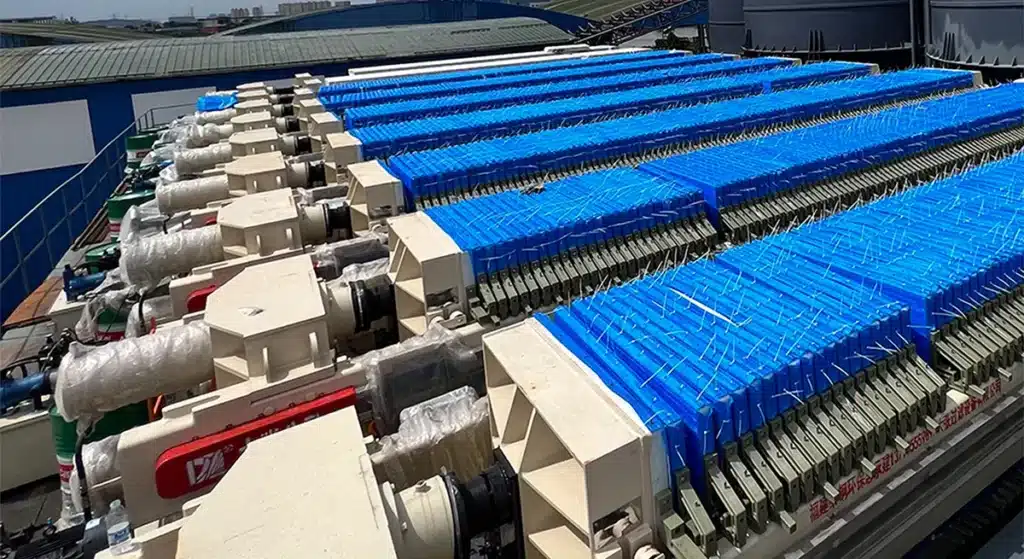
At DZ Environmental we manufacture both program-controlled chamber and automatic membrane filter presses, so the comparison is based on the same frame, cloth, and control platform.
| Factor | Chamber filter press | Membrane filter press |
|---|---|---|
| Typical cake moisture (municipal) | 65–75% | 55–65% |
| Extra squeeze step | No | Yes (air or water) |
| Cycle time | Longer fill-only | Often shorter |
| Capital cost | Lower | Higher |
| Best when | Moderate dryness is enough | Disposal or transport cost is high |
Does membrane squeeze always shorten the cycle?
Yes, when the cake is compressible. After chambers fill, membranes inflate and push remaining filtrate out faster than extra pump time can. Many plants cut 20–40% off total cycle versus a chamber-only run. If sludge is sandy or poorly conditioned, squeeze adds little and cycle time stays similar.
How much does polymer conditioning matter?
Conditioning often matters more than plate type. Under-dosed sludge blinds cloth and leaves wet cake on both machines. Over-dosing creates sticky cake that discharges poorly. Target a clear filtrate and a cake that releases cleanly. Program-controlled machines integrate feed, squeeze, and blowdown so operators can lock a stable recipe.
When is a chamber filter press the better buy?
Choose a chamber press when cake at 65–75% moisture is acceptable, disposal is not billed strictly by wet weight, and capital budget is tight. Hydraulic chamber filter presses remain the workhorse for many municipal plants and industrial slurries that drain freely.
When should you specify a membrane press?
Specify membrane plates when landfill, incineration, or haulage cost drops sharply with every moisture point, or when downstream drying energy is expensive. From the projects we have engineered, membrane presses pay back fastest on high-VS digested sludge and plants that already run tight polymer control.
What else controls dryness besides plate type?
Cloth weave and blinding, feed solids, fill pressure profile, core blow, and cake discharge method. Automatic water washing filter presses keep cloth open longer. Stainless steel filter presses are used where corrosion or hygiene rules out carbon-steel frames.
FAQ
What moisture is realistic for municipal sludge on a filter press?
With good conditioning, chamber units often land at 65–75%; membrane units at 55–65%. Bench tests on plant sludge are required.
Does higher squeeze pressure always mean drier cake?
Only up to the sludge’s compressibility limit. Excess pressure can pack fines into the cloth and slow the next cycle.
Can a chamber press match membrane dryness with longer cycles?
Usually no. After a point, extra pump time adds little water removal without mechanical squeeze.
Is membrane plate maintenance higher?
Membranes and squeeze piping add parts. Quality CNC-machined plates and robotic welding, as used on the membrane presses we build, reduce leak and fatigue issues.
Do both types use the same filter cloth?
Often yes, but membrane cycles may need cloth rated for squeeze pressure and frequent wash.
How does automation change results?
PLC control of fill, squeeze, blow, and plate shift reduces operator variation and keeps moisture more consistent batch to batch.
Which industries besides municipal use both types?
Mining tailings, chemical slurries, food residues, and pharmaceutical intermediates. Choice still follows cake dryness versus capex.