
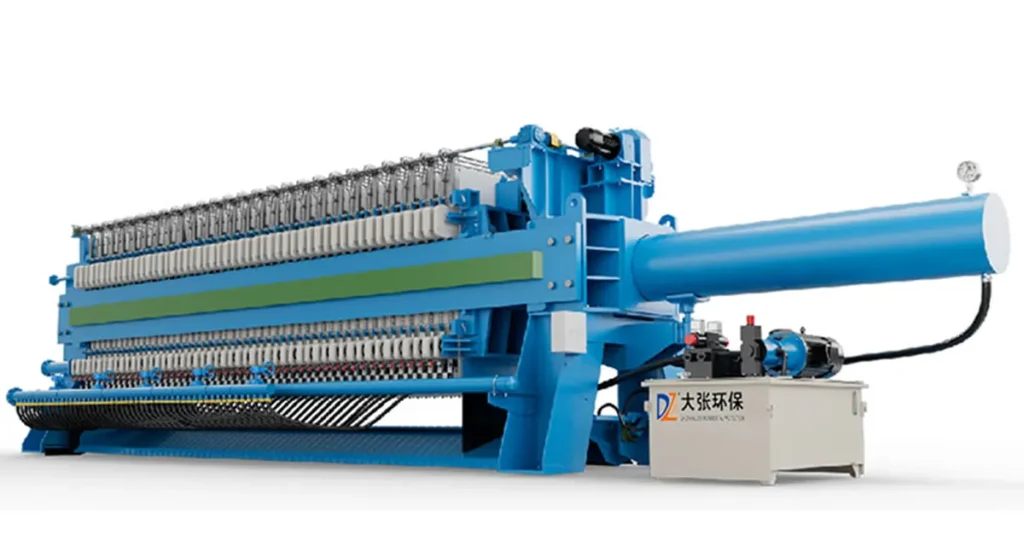
A cloth traveling filter press uses a continuous filter-cloth movement system to release cake and clean the cloth in one automated sequence. When plates open, the cloth advances so cake drops cleanly—even sticky or thin cakes that cling on conventional chamber or membrane presses. Simultaneous washing restores permeability without separate manual steps. At DZ Environmental we build Cloth Traveling Filter Presses for mining, chemical, and wastewater duties where incomplete discharge and cloth blinding otherwise force extra labor and longer cycles.
How does cloth travel improve cake discharge?
Cloth travel physically moves the filter media after the filtration cycle so cake peels away from the plate surface. Sticky, fine, or low-thickness cakes that remain attached on fixed-cloth presses release more reliably. This reduces residual solids left in the chambers and shortens the open-and-discharge phase of the cycle.
What does automatic cloth cleaning add?
As the cloth travels, high-pressure washing sprays clean both sides. Blinding is controlled without stopping production for manual scrubbing. Cycle times stay more consistent because permeability recovers every cycle instead of declining over a shift. In the presses we build, the traveling and washing functions are integrated under PLC control so the sequence repeats without operator intervention.
When is a cloth traveling design the better fit?
Choose it when your slurry produces sticky or thin cakes, when manual discharge labor is high, or when you need continuous high-duty operation with minimal operator attendance. Mining tailings, certain chemical slurries, and municipal or industrial sludge that resists clean release are common applications. Standard chamber or membrane presses remain suitable when cake releases easily and cloth washing can be handled by simpler systems.
| Feature | Cloth Traveling Filter Press | Conventional Chamber/Membrane |
|---|---|---|
| Cake release | Cloth movement + gravity | Gravity / plate shift only |
| Sticky or thin cake handling | Strong | Often incomplete |
| Cloth cleaning | Integrated automatic wash | Separate wash cycle or manual |
| Labor for discharge & wash | Minimal | Higher |
| Best for | Sticky cake, high automation need | Easy-release cake, lower duty |
How does automation affect daily operation?
Program control sequences closing, filtration, open, cloth travel, discharge, and wash. Operators monitor rather than intervene on every cycle. Stable hydraulic systems and German-standard plates support the mechanical loads of continuous cloth movement. From the projects we have engineered, plants that previously needed two operators for discharge often run the cloth-traveling machines with far less hands-on time.
What capacity range is available?
Cloth traveling models cover a wide filtration-area band. Typical series use 1100 mm or 1500 mm plates with chamber counts from roughly 10 to 80, giving filtration areas from about 20 m² up to over 290 m² depending on configuration. Match plate size and chamber volume to your dry-solids throughput and cycle-time target rather than selecting area in isolation.
How do you protect cloth life on a traveling system?
Cloth wear comes from mechanical travel, chemical attack, and residual solids. Keep polymer conditioning stable, avoid over-dosing that creates sticky residue, and ensure wash water pressure and nozzles stay effective. Correct cloth weave and material for the slurry reduce abrasion during travel. Automatic cleaning actually extends useful life when it prevents progressive blinding that would otherwise force aggressive scraping.
FAQ
What is the main advantage of a cloth traveling filter press?
Automatic cloth movement delivers complete cake discharge and integrated washing in one sequence, which is especially useful for sticky or thin cakes.
Can it handle mining tailings?
Yes. Tailings and other fine, sometimes sticky solids are common applications because residual cake left in chambers is reduced.
Does cloth travel replace a membrane squeeze?
No. Cloth travel solves discharge and cleaning. Moisture targets still depend on feed pressure, conditioning, and whether membrane plates are specified for the process.
How much labor does it typically save?
Plants that previously needed operators to assist discharge and wash often reduce that hands-on time substantially once the traveling and wash sequence is stable.
Is every slurry suitable?
Easy-release mineral cakes may not need the extra mechanism. Sticky biological or chemical cakes and high-duty continuous operation benefit most.
What plate sizes are common?
Series commonly use 1100×1100 mm and 1500×1500 mm plates with multiple chamber counts to cover a wide filtration-area range.
How is the sequence controlled?
Intelligent PLC control coordinates hydraulic closing, filtration, cloth travel, discharge, and automatic washing so the full cycle repeats consistently.