
Cake moisture, cycle time, and total operating cost determine whether a filter press meets your disposal limits and daily dry-solids throughput. With proper polymer conditioning, a chamber filter press typically discharges municipal mixed sludge at 60–70% moisture. An automatic membrane filter press commonly reduces that by 5–12 percentage points into the 50–62% range while shortening the filtration hold. At DZ Environmental we manufacture both program-controlled chamber and automatic membrane filter presses, so selection follows your actual moisture target and cycles-per-shift requirement rather than a default technology preference.
What cake moisture should you target?
Target the moisture your disposal route or drying step requires. Chamber presses rely on feed-pump pressure alone (typically 0.6–0.8 MPa) and leave most polymer-conditioned municipal sludges at 60–70% moisture. Membrane presses add a secondary water squeeze (0.8–1.6 MPa) after the chambers fill; the extra compression commonly removes another 5–12 points. Mining and high-inorganic cakes run drier on both styles. Confirm the range on your sludge—polymer dose and feed solids often move the result as much as plate type.
| Factor | Chamber Filter Press | Membrane Filter Press |
|---|---|---|
| Typical municipal cake | 60–70% moisture | 50–62% moisture |
| Secondary squeeze | None | 5–15 min at 0.8–1.6 MPa |
| Capital cost | Lower | Higher |
| Best fit | Stable 65–70% limit | Tight disposal or haulage cost |
How does cycle time set daily capacity?
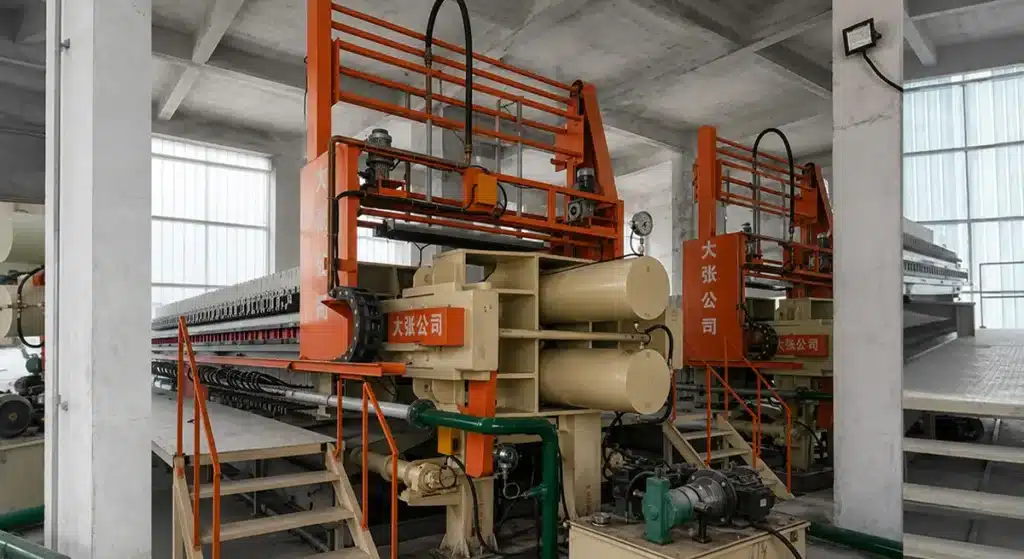
Capacity equals dry tons per day, not plate area alone. A full cycle includes fill, filtration, optional squeeze, open, discharge, and cloth wash—commonly 60–180 minutes. Membrane expression lets you stop the fill earlier and finish with a short squeeze, often cutting total cycle time 30–50% versus a chamber press chasing the same dryness. Higher throughput on the same footprint reduces the number of machines or shifts required. Program-controlled automation keeps the pressure profile and discharge consistent so cycle times do not drift.
When does the membrane step pay for itself?
Use a membrane filter press when each moisture point saves more in haulage, landfill, or thermal drying than the added capital and diaphragm maintenance. On compressible biological sludge the 5–12-point gain is reliable; on easy-filtering mineral slurries the incremental dryness may be smaller. Stay with a chamber press when 65–70% moisture is acceptable and capital is constrained. Both designs can be fully automatic with plate shifting and cloth washing. In the membrane presses we build, CNC-machined plates and robotic welding keep the squeeze even across the pack.
How does automation affect labor and consistency?
Program-controlled machines sequence fill, pressure ramp, squeeze, open, and discharge without constant operator intervention. Automatic cloth washing (high-pressure water jets or traveling cloth systems) restores permeability between cycles, prevents progressive blinding, and extends cloth life. The result is more stable cycle times and fewer manual interventions. Our program-controlled machines integrate these functions so operators monitor rather than manually sequence each stage.
What limits cloth life and filtrate quality?
Cloth blinding from incomplete washing or under-conditioned sludge is the most common cause of rising cycle times and wetter cake. Correct polymer dose, regular automated washing, and matching cloth micron rating to particle size keep flux high. Stainless-steel wetted parts or full stainless construction may be required for corrosive or hygienic service; otherwise standard polypropylene plates and coated frames suffice. From the projects we have engineered, consistent conditioning and automated washing usually deliver larger gains than simply raising feed pressure.
FAQ
What moisture can I realistically expect on municipal sludge?
Chamber presses typically reach 60–70%; membrane presses 50–62% with polymer conditioning. Confirm with a pilot or jar-test program on your sludge.
Does a membrane press always give shorter cycles?
Often yes—30–50% shorter when targeting the same dryness—because the squeeze replaces a long low-pressure hold. On non-compressible cakes the difference shrinks.
Is higher feed pressure the best way to dry the cake?
No. Once the cake is formed, membrane squeeze removes more free water than simply raising pump pressure, especially on fine, compressible solids.
How important is automatic cloth washing?
Very. Progressive blinding is the main reason cycle times lengthen over weeks. Automated washing maintains flux and cloth life far better than manual cleaning.
Can one press handle two different sludges?
Only if they are similar in particle size, compressibility, and conditioning needs. Large differences usually require separate machines or major recipe changes.
Do I need 316L stainless everywhere?
Not always. 304 or coated carbon steel works for many municipal and neutral industrial streams. Specify 316L or full stainless when chlorides, acids, or hygienic standards demand it.
How do I size the press?
Start with required daily dry solids, target moisture, and realistic cycle time (including discharge and wash). Plate area follows from those numbers, not the reverse.