
A stainless steel filter press is justified when chloride, acid, high-salinity brine, or food- and pharma-grade hygiene would corrode carbon steel and raise lifetime cost or contamination risk. Carbon steel remains the economical default for municipal sludge and many neutral industrial slurries. Switch to stainless when corrosion or product purity outweighs the higher material price. At DZ Environmental we build stainless steel filter presses alongside program-controlled chamber and membrane machines so the same process logic can run in corrosive or hygienic duty.
When does carbon steel fail in filter press service?
Carbon steel fails when free chloride, low pH, or repeated wet–dry cycles attack uncoated surfaces. Typical failure points are plate edges, tie rods, manifolds, and residual cake pockets that stay wet between cycles. Coatings buy time in moderate environments but chip under cake discharge and cloth wash. For continuous acid or chloride exposure, stainless steel is the practical choice.
Which process fluids justify stainless steel?
Use stainless steel for chloride-bearing brines, acidic chemical slurry, food and pharmaceutical cake that must meet hygiene standards, and high-salinity industrial filtrate. Municipal sludge with low chloride and neutral pH rarely needs full stainless construction. From the projects we have engineered, the decision usually turns on measured chloride, pH, and whether filtrate or cake contacts product streams.
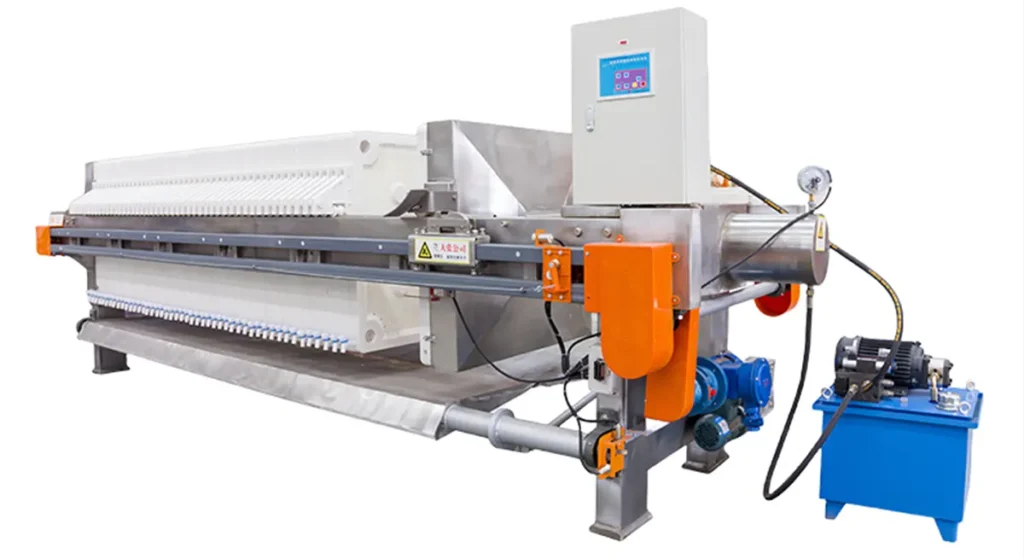
Do you need stainless plates, frame, or both?
Stainless plates protect the filtration surface; a stainless frame protects structural members. Many plants specify stainless plates with a coated carbon-steel frame when only the process side is aggressive. Full stainless construction is justified when the machine sits in a corrosive wash-down area or must meet sanitary design rules. Our stainless steel filter presses can be supplied as plate-only upgrades or complete stainless frames.
How do 304 and 316 stainless compare?
304 stainless resists general corrosion and suits many food and low-chloride duties. 316 or 316L adds molybdenum and improves pitting resistance in chloride and mild acid service. For filter presses, 316L is the more common choice when chloride is elevated or acid cleaning is routine. Match the grade to the fluid analysis rather than defaulting to the highest alloy.
| Material | Typical use | Chloride tolerance | Relative cost |
|---|---|---|---|
| Carbon steel (coated) | Municipal, neutral slurry | Low | Baseline |
| 304 stainless | Food, low-chloride | Moderate | Higher |
| 316 / 316L | Chloride, mild acid | Higher | Highest |
What operating costs change with stainless steel?
Capital rises, but recoating labor, unplanned downtime, and contamination risk often fall. Stainless surfaces release cake more cleanly in sticky applications and tolerate stronger cleaning agents. Program-controlled automatic membrane or chamber machines in stainless keep the same cycle logic while meeting material requirements.
FAQ
Is stainless required for every chemical sludge? No. Only when chloride, acid, or hygiene rules make carbon steel unreliable.
Can you mix stainless plates with a carbon-steel frame? Yes. This hybrid approach is common when only process surfaces need higher resistance.
Does stainless improve cake dryness? Not by itself. Dryness still depends on conditioning, pressure, and membrane squeeze.
What grade is typical for plates? 316L is widely specified for chloride or acid service; 304 often suffices for food-grade neutral streams.
What fluid data should you provide? pH, chloride level, temperature, and any acid or caustic cleaning regime.