
An automatic water washing filter press works by combining standard pressure filtration with an automated high-pressure cloth cleaning step. After the filter cake is discharged, traveling spray nozzles wash both sides of each filter cloth to remove residual solids, restore permeability, and prepare the machine for the next cycle with minimal manual intervention.
At DZ Environmental we manufacture automatic water washing filter presses as part of our program-controlled range. The design is frequently selected by plants that need consistent throughput with reduced manual cloth cleaning.
What Are the Main Steps in the Operating Cycle?
The complete cycle typically follows these stages:
- Plate closing – The hydraulic system closes and locks the plate pack, forming sealed filtration chambers.
- Slurry feeding – A feed pump forces slurry into the chambers under pressure. Solids are retained by the filter cloths while filtrate drains away.
- Cake formation – Solids build until the chambers are full and filtrate flow drops.
- Feed stop – The pump stops when design pressure is reached or filtrate flow falls below the set point.
- Cake discharge – The plate pack opens and automatic plate-shifting mechanisms allow the cakes to fall out.
- Cloth washing – High-pressure spray nozzles travel between the plates and direct water jets onto both sides of each cloth.
- Plate closing – The plates close again and the next cycle begins.
Washing frequency, duration, and water pressure are controlled by a PLC and adjusted according to slurry characteristics.
How Does the Automatic Washing System Operate?
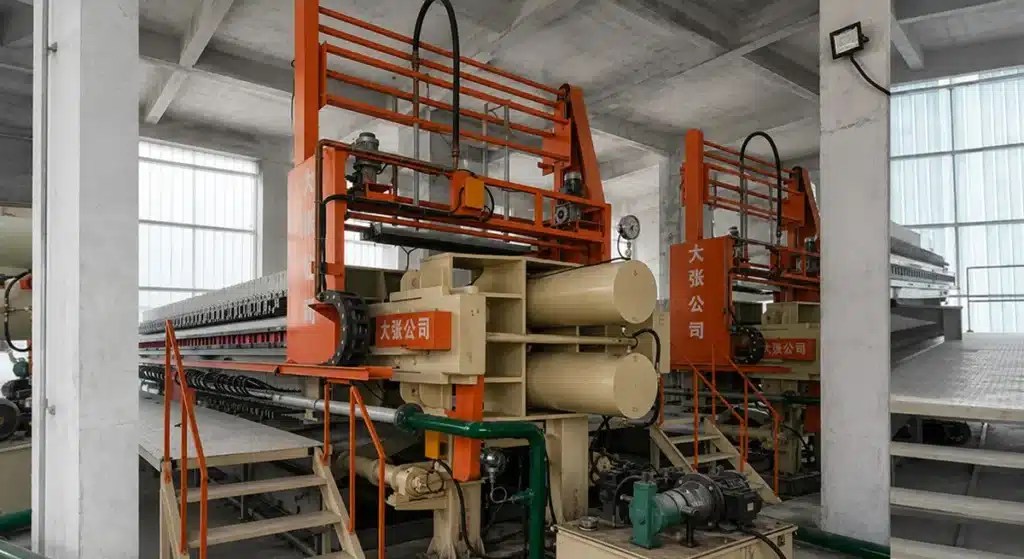
After cake discharge the plates remain separated. A traveling spray bar moves along the plate pack. High-pressure water is pumped through nozzles that create focused jets covering each cloth. Wastewater is collected and drained or treated. This prevents progressive cloth blinding that would otherwise slow filtration.
What Role Does the Control System Play?
A PLC coordinates plate closing, feeding, pressure monitoring, cake discharge, washing activation, and restart. Operators can set washing intervals, spray time, and water pressure. Many systems allow fully automatic or semi-automatic modes. In the automatic water washing filter presses we build, the PLC integrates these functions for reliable continuous operation.
What Are the Key Components Involved?
- Filter plates (chamber or membrane) and filter cloths
- Hydraulic closing and locking system
- Feed pump and piping
- Automatic plate-shifting mechanism
- High-pressure water pump and traveling spray nozzles
- PLC control system with pressure and flow sensors
High-precision manufacturing supports structural consistency and long-term sealing performance.
How Does Washing Affect Performance?
By keeping cloth pores open, washing helps maintain filtration speed closer to design values, reduces the rise in cycle time over successive batches, and extends cloth service life. The washing step adds a short interval after discharge, but the net effect on daily throughput is often positive in blinding-prone applications.
Frequently Asked Questions
Does washing happen after every cycle?
Not necessarily. Frequency is programmable. Many plants wash every 10–50 cycles.
What water pressure is typically used?
Systems use focused high-pressure jets. Exact pressure depends on cloth type and residual solids.
Can the machine run without washing?
Yes. The washing function can usually be disabled when the slurry does not cause rapid blinding.
Is the process the same for membrane and chamber plates?
Filtration and discharge steps are similar. Membrane plates add a squeeze phase before discharge; cloth washing remains the same.
What happens to the wash water?
It is collected and either discharged or sent for treatment according to site requirements.
An automatic water washing filter press maintains consistent solid-liquid separation by automatically cleaning the filter cloths after cake discharge, reducing the impact of cloth blinding on filtration speed and cycle time.