
No. A membrane filter press is not always lower cost.
It becomes the better total-cost choice when the extra dryness pays for itself — mainly through lower disposal, transport, or drying costs. If a chamber filter press already meets your outlet moisture limit, the simpler machine is often the lower overall cost.
When membrane usually wins on cost
- Disposal or haulage is expensive: Dropping cake moisture by 5–12 percentage points (e.g., from ~65–70% toward ~50–62% on municipal sludge) can cut wet cake mass by a large fraction for the same dry solids. That saving often outweighs the higher capital and slightly higher energy of the membrane step.
- You have a hard moisture limit (landfill, incineration, or further drying) that a chamber press struggles to hit reliably.
- You run many cycles: Membrane squeeze can shorten the slow end of filtration, so throughput per shift may rise even though each cycle has an extra squeeze step.
When chamber is often the lower-cost option
- Your process already accepts ~60–70% moisture (typical chamber result on polymer-conditioned municipal sludge).
- Capital budget is tight and disposal cost per point of moisture is modest.
- Duty is intermittent or low-cycle; the extra complexity of membrane plates and squeeze systems adds little value.
Cost elements to compare (not just purchase price)
| Cost driver | Chamber filter press | Membrane filter press |
|---|---|---|
| Capital | Lower | Higher (membrane plates + squeeze system) |
| Cake moisture (municipal) | Often 60–70% | Often 50–62% (5–12 points drier) |
| Disposal / transport | Higher wet mass | Lower wet mass — usually the largest saving |
| Energy / cycle | Lower | Slightly higher (squeeze step) |
| Plate / diaphragm | Standard recessed PP | Membrane plates; diaphragm is a wear part |
| Throughput | Depends on fill + hold | Can be similar or better if squeeze shortens the tail |
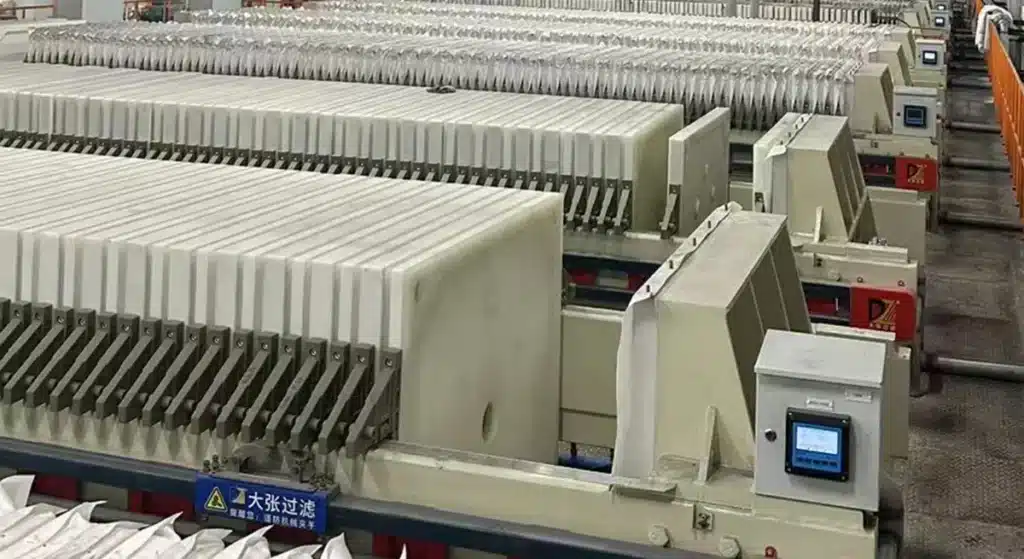
At DZ Environmental we manufacture both program-controlled chamber filter presses and automatic membrane filter presses. The right choice is driven by your sludge, your moisture limit, and the real cost of moving or further treating wet cake — not by assuming membrane is automatically cheaper.
If you share your target moisture, approximate dry-solids throughput, and whether disposal or drying is the main cost, the trade-off can be narrowed further.