
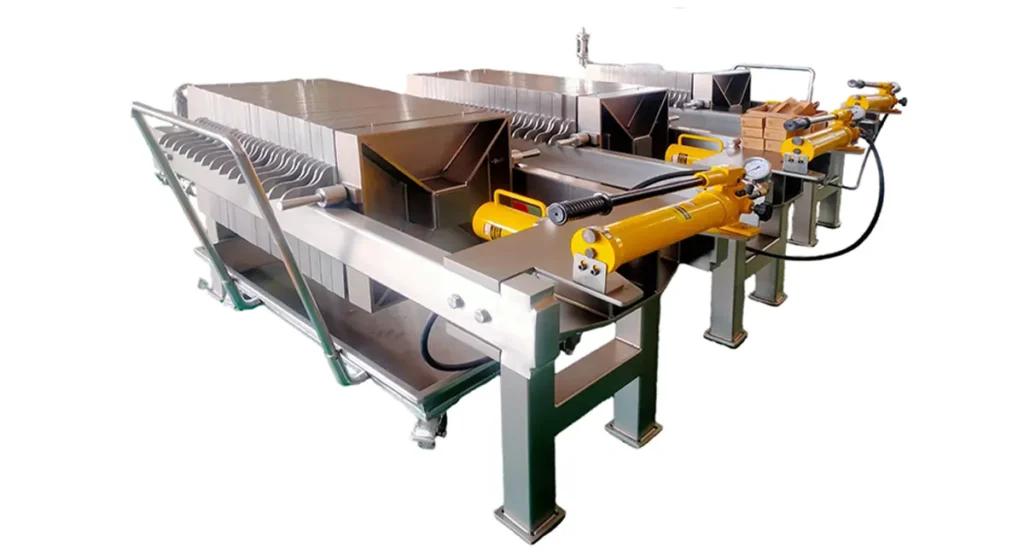
A hygienic stainless steel filter press is justified when cake or filtrate contacts food, beverage, or pharmaceutical streams and must meet cleanability and product-purity rules that carbon steel cannot satisfy. Coatings chip, crevices trap residue, and corrosion risks contamination. 316L stainless with smooth finishes, minimal dead zones, and CIP-compatible design is the practical baseline. At DZ Environmental we build stainless steel filter presses, including program-controlled chamber and membrane versions, for hygienic duty.
What makes a filter press “hygienic” rather than just stainless?
Hygienic design goes beyond alloy grade. Product-contact surfaces should be smooth, continuously welded where practical, and free of pockets that hold cake or cleaning solution. Plate edges, manifolds, and discharge chutes need profiles that drain and rinse cleanly. Cloths and seals must tolerate food- or pharma-grade cleaners. From the projects we have engineered, decisive factors are CIP access, residual moisture after rinse, and certificates.
Which streams need hygienic construction?
Use hygienic stainless for food and beverage recovery cake, pharmaceutical intermediates, fermentation and biotech broths, and streams where filtrate returns to process or cake is processed as product. Neutral municipal sludge does not require this design. High-sugar, high-protein, or fatty feeds benefit from stainless that releases cake cleanly and tolerates hot caustic or acid washes.
Why is 316L preferred?
316L adds molybdenum for better pitting resistance and is the accepted grade for chloride-bearing cleaners and many food-contact duties. 304 can suit low-chloride, mild environments, but 316L reduces risk when CIP includes chlorides. Low-carbon “L” grades limit sensitization after welding. Match grade and finish to cleaning chemistry and product specification.
| Requirement | Carbon steel | 304 | 316L |
|---|---|---|---|
| Product contact | Not suitable | Limited | Preferred |
| CIP with chlorides | Poor | Moderate | Better |
| Cleanability | Poor | Good | Good |
| Typical use | Non-hygienic | Mild food | Food, pharma, CIP |
Full stainless or only process-contact parts?
Process-contact parts—plates, manifolds, filtrate piping, and discharge surfaces—must be hygienic stainless. The frame can remain coated carbon steel if it stays outside the wash-down zone. Full stainless frames are justified when the machine is washed daily or standards require uniform materials. Our stainless steel filter presses can be plate upgrades or complete hygienic machines.
How do automation and washing help?
Program-controlled automatic membrane or chamber filter presses keep fill, squeeze, and discharge sequences repeatable, reducing operator contact and residual cake variation. Automatic plate shifting and optional washing support CIP. Consistent pressure profiles limit wet spots that hinder cleaning. Material choice prevents corrosion; automation limits residue.
FAQ
Is 316L required for every food application? Not always. Low-chloride streams may accept 304; 316L is safer when CIP or product rules are strict.
Does hygienic design change cake dryness? No. Dryness still depends on conditioning, pressure, and membrane squeeze.
Can membrane plates be hygienic stainless? Yes. Food and pharma membrane presses use stainless contact surfaces and compatible seals.
What data is needed before specifying? Product type, cleaning agents and temperature, surface-finish or certificate needs, and whether the frame is wash-down.
Is carbon steel acceptable in a food plant? Only for non-product-contact equipment outside hygienic zones.