
Automation is one of the highest-leverage decisions when you specify a filter press. Program control of plate closing, feeding, membrane squeeze, opening, and optional cloth washing delivers more consistent cake moisture, shorter repeatable cycles, and lower labor demand than manual or semi-automatic operation. In multi-cycle or variable-sludge plants the difference appears in cake quality and cost.
What does full automation actually control?
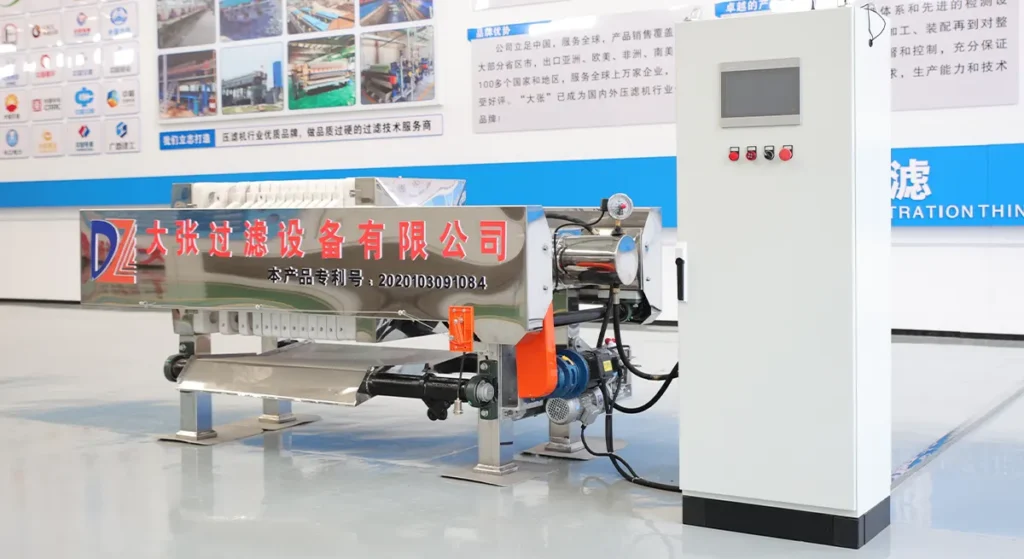
A program-controlled filter press uses a PLC and touch-screen sequence to manage the full cycle: hydraulic close, feed pump start and pressure ramp, membrane squeeze (when fitted), cake discharge, and optional high-pressure cloth washing. Sensors confirm plate position and pressure before the machine advances. Our program-controlled machines integrate these functions so the operator starts the sequence and monitors.
How much labor does automation remove?
Manual plate shifting and cloth cleaning can occupy one or two operators for much of each cycle. Automatic plate shifting and optional automatic water washing reduce that work to supervision. In multi-shift plants labor savings often recover the automation package in one to three years.
Does automation improve cake consistency?
Yes. Fixed pressure profiles and timed squeeze steps reduce cycle-to-cycle scatter that appears when operators adjust feed time or closing pressure by feel. Cake moisture becomes more predictable. From the projects we have engineered, plants moving to full program control typically report tighter moisture ranges.
When is semi-automatic still acceptable?
Semi-automatic or hydraulic chamber units remain practical when daily throughput is low, sludge is stable, and labor is available. If you run only a few cycles per day and dryness targets are modest, full automation may not be justified. At DZ Environmental we manufacture both hydraulic chamber and fully program-controlled membrane and chamber machines so automation can match the duty.
How does automation affect cycle time and throughput?
| Aspect | Manual / Semi-auto | Full program control |
|---|---|---|
| Plate shifting | Operator-dependent | Consistent, faster |
| Pressure profile | Variable | Fixed and repeatable |
| Cloth washing | Manual, often delayed | Optional automatic |
| Cycle scatter | Higher | Lower |
| Operator attention | Continuous | Start-and-monitor |
Automation shortens non-filtration steps and keeps pressure on the correct curve, raising dry-solids throughput per shift.
What safety and reliability gains come with automation?
Interlocks prevent opening under pressure and confirm plates are closed before feeding starts. Automatic systems log cycle data, making gradual cloth blinding or pump wear easier to diagnose. In the membrane presses we build, the same PLC controls squeeze, safety interlocks, and optional cloth washing.
FAQ
Is full automation worth the extra capital cost?
Yes when you run multiple cycles per day or need tight moisture control. Labor and consistency savings usually recover the premium.
Can automation work with both chamber and membrane presses?
Yes. Program control applies to both; membrane units add the squeeze step.
Does automation eliminate operators?
No. Operators still start cycles, monitor alarms, and handle cake or cloth checks.
How important is automatic cloth washing?
Critical when blinding is frequent. Automatic washing keeps rate closer to new cloth.
What control system is typical?
PLC with touch-screen HMI is standard. Recipes can be stored for different sludge.
Will automation help if sludge quality varies?
Yes. Fixed sequences and logged data make polymer or cycle adjustments easier.