
When you specify a filter press, cake moisture, cycle time, and lifetime cost matter more than plate size alone. A program-controlled chamber filter press relies on feed pressure to form cake. A program-controlled automatic membrane filter press adds a squeeze step after filtration, typically cutting residual moisture by 5–12 points and shortening cycles on compressible sludge. Match the machine to your solids, disposal cost, and labor.
What cake moisture can you realistically expect?
Chamber presses commonly discharge municipal or industrial cake at 50–62% moisture when polymer conditioning and feed pressure (0.6–1.2 MPa) are correct. Membrane presses often reach 40–55% on the same feed because the diaphragm squeeze expels water that filtration pressure alone cannot move. Mineral and lime-conditioned cakes usually gain more dryness than elastic organic sludge.
When does a chamber filter press make more sense?
Choose a chamber press when your cake already meets landfill or dryer limits, slurry is relatively free-draining, and capital cost or simplicity matters more than extra dryness. Hydraulic and program-controlled chamber units handle stable municipal sludge, food residues, and coarse mineral slurries. At DZ Environmental we manufacture both types so the choice can follow the process.
When should you specify a membrane filter press?
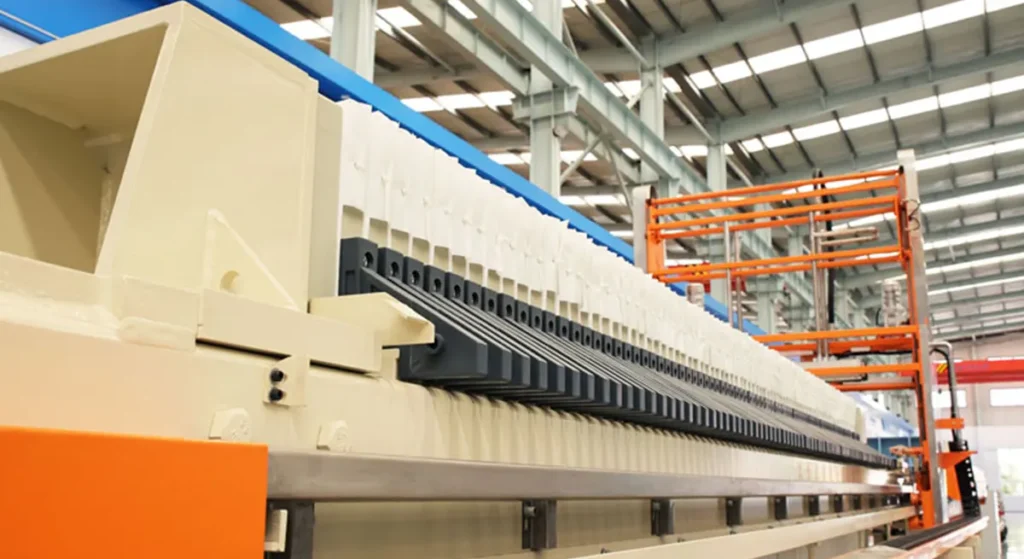
Specify a membrane press when disposal is charged by wet ton, you need shorter cycles, feed solids vary, or chambers do not always fill completely. The squeeze still works on a partial cake. In the membrane presses we build, high-precision CNC machining and robotic welding keep plate sealing reliable under repeated 0.8–1.6 MPa squeeze. That combination is typical for chemical sludge, tailings, and high haulage cost.
How do cycle time and cost compare?
| Factor | Chamber filter press | Membrane filter press |
|---|---|---|
| Typical cake moisture | 50–62% | 40–55% |
| Extra dewatering step | Feed pressure only | Membrane squeeze after fill |
| Cycle flexibility | Needs full chambers | Works with partial fill |
| Capital cost | Lower | Higher |
| Best fit | Stable, free-draining feed | High disposal cost, variable sludge |
Membrane cycles are often shorter because squeeze replaces a long low-flow tail on the feed pump. Model polymer, cloth life, labor, and wet-cake haulage. Our program-controlled machines integrate plate shifting and optional automatic water washing to cut cloth work.
Which specifications actually change performance?
Fix filtration area and chamber depth to your dry-solids load, then set feed pressure, squeeze pressure, and cloth type to particle size and compressibility. Stainless steel filter presses belong where corrosion or hygiene rules out standard PP plates. From the projects we have engineered, mismatched cloth or unstable polymer dose causes more wet cake than an undersized frame.
FAQ
Is a membrane press always drier than a chamber press?
Yes on the same well-conditioned feed, typically by 5–12 points. Poor flocculation can erase that gap.
Can a chamber press reach landfill-dry cake?
Yes when sludge is mineral-rich or well conditioned and 50–62% moisture is acceptable.
Does squeeze always shorten the cycle?
Usually. Very free-draining slurries may see little change.
How important is automation?
Program control of close, feed, squeeze, open, and optional cloth wash reduces labor and cycle scatter.
What pressure range is typical?
Feed 0.6–1.2 MPa; membrane squeeze often 0.8–1.6 MPa.
Will cloth washing pay back?
Yes where blinding is frequent; automatic water washing holds filtration rate closer to new cloth.