
Buyers rarely lose money because a filter press “does not work.” They lose money because cake moisture stays 4–8 points higher than expected, cycles run longer than the plant can staff, or the machine was sized for a sludge that only exists on paper. The decisions that actually move cost are cake dryness, cycle time, sludge chemistry, polymer conditioning, and total operating cost—not plate size alone. Chamber and membrane filter presses can both succeed when they are matched to those variables. The sections below answer the questions plant engineers and procurement teams ask before they lock a specification.
What cake moisture can you realistically expect from a filter press?
Realistic municipal cake moisture on a well-conditioned sludge is typically 55–65% for a chamber filter press and 50–60% for a membrane filter press, with industrial mineral sludges often landing several points drier. Those ranges assume stable feed solids, correct polymer dose, intact cloths, and a complete pressure profile. Promising “30% moisture on mixed municipal sludge” without a pilot test is not a specification—it is a risk.
Cake moisture is the number that drives disposal weight, trucking, landfill fees, and any downstream dryer load. A 5-point drop in moisture can cut wet cake mass by more than 10%, which is why membrane squeeze is specified when disposal cost dominates the business case. From the projects we have engineered at DZ Environmental, the gap between chamber and membrane results is largest on compressible industrial cakes and smallest on poorly flocculated, high-fiber municipal sludge.
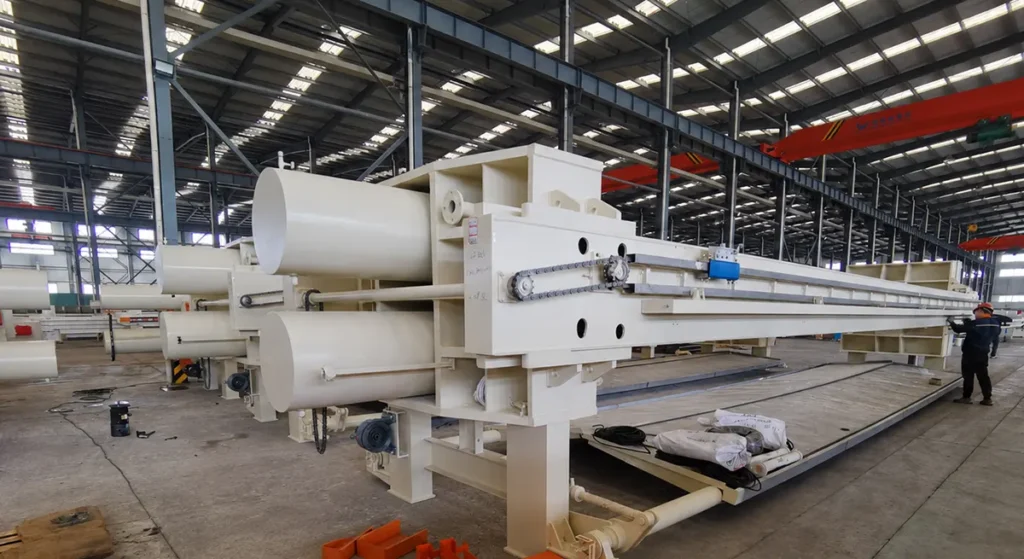
Moisture is not only a machine property. Feed solids, particle size, organic fraction, and how the cake is released all matter. If the plant cannot hold polymer residual and mixing energy steady, the press will not hold moisture steady either.
Chamber or membrane: which filter press type actually lowers your cost?
A membrane filter press lowers cost when drier cake or shorter cycles repay the higher plate and squeeze-system investment; a chamber filter press lowers cost when sludge is easy to dewater, disposal is cheap, or capital must stay tight. The correct choice is a total-cost decision, not a technology preference.
Chamber plates form a fixed-volume cavity and dewater with feed-pump pressure only, typically 0.6–1.6 MPa depending on plate rating. Membrane plates add a squeeze step after the cake has formed, commonly 0.8–1.6 MPa on the diaphragm, which expels interstitial water the pump can no longer move. At DZ Environmental we manufacture both program-controlled chamber and automatic membrane filter presses, so the selection is driven by process economics rather than a single product line.
| Factor | Chamber filter press | Membrane filter press |
|---|---|---|
| Typical municipal cake moisture | 55–65% | 50–60% (often 3–8 points drier) |
| Typical industrial mineral cake | 25–45% | 18–35% |
| Cycle structure | Feed until packed | Shorter feed + squeeze |
| Capital cost | Lower | Higher (membranes, squeeze circuit) |
| Best economic case | Moderate disposal cost, stable easy sludge | High disposal cost, hard-to-dewater or variable sludge |
| Mechanical complexity | Simpler plates | Membranes and squeeze media to maintain |
Membrane technology does not automatically win. If landfill or incineration pricing is low and the plant already meets cake-handling limits on a chamber press, the extra squeeze hardware adds cost without changing the operating result. If every wet ton is expensive, the membrane squeeze is often the cheaper machine over five to eight years.
How does cycle time affect plant capacity and operating cost?
Cycle time sets how many tons of dry solids a given filtration area can process per day, so a shorter reliable cycle is extra capacity without a second press. A municipal cycle commonly runs 2–4 hours including fill, filtration, optional squeeze, open, discharge, and close. Industrial mineral cycles can be much shorter when solids are high and cakes release cleanly.
Membrane presses often shorten total cycle time even though they add a squeeze step. Filtration can stop once a coherent cake exists instead of pumping against a packed chamber for diminishing returns. That trade—less pump time, more squeeze time—is why many plants see higher daily throughput on the same plate count.
Labor follows cycle design. Manual plate shifting and cloth scraping on a multi-hour municipal cycle consume a full operator. Program-controlled machines integrate hydraulic opening, plate shifting, and drip trays so one operator can cover more than one press. Our program-controlled machines integrate these functions so cycle consistency does not depend on shift-to-shift technique.
Capacity planning should use conservative cycle times from similar sludge, not catalog minimums. A press that “can” cycle in 90 minutes but actually needs 3 hours after polymer upsets is undersized.
What sludge characteristics matter most before you specify a machine?
The sludge properties that decide press type, area, and cloth are feed solids concentration, particle size distribution, organic versus mineral fraction, and how the floc responds to pressure. Without those four, plate count is a guess.
Filter presses work best when feed solids are high enough to fill chambers in a reasonable time. Thin slurry (for example 1–2% solids with no thickening) extends fill time, wastes polymer, and can leave incomplete cakes. Many successful municipal installations sit in the 3–6% feed-solids range after thickening. Mining tailings and chemical precipitates often arrive much higher and dewater faster.
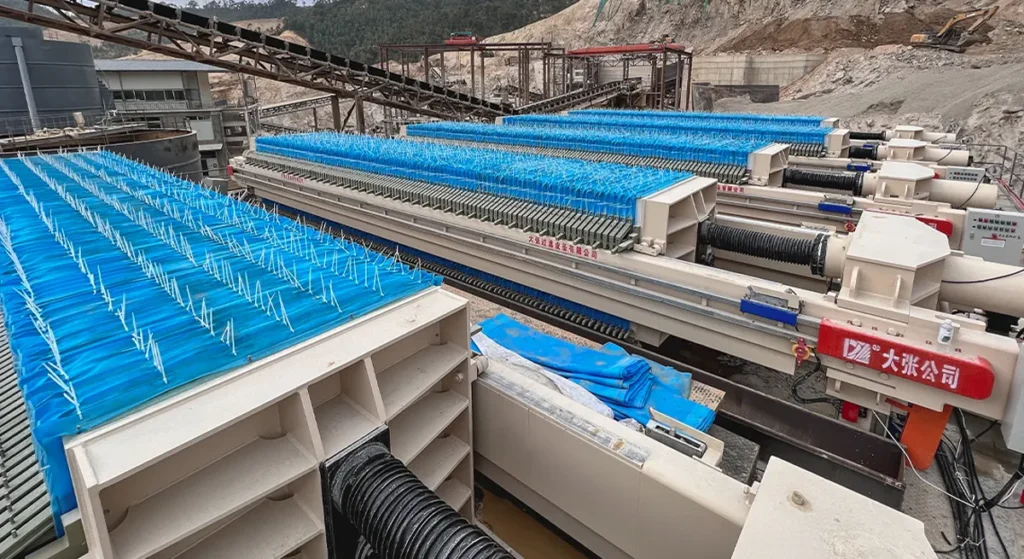
Organic municipal sludge is compressible and springy. Excess pressure without good floc structure can seal the cake surface and trap water. Mineral sludges and lime-conditioned cakes are more rigid; they accept high squeeze pressure and usually release drier. That is why a membrane press on phosphate or metal-hydroxide sludge can look dramatically better than the same machine on mixed primary-plus-WAS sludge.
Cloth selection follows particle size and chemistry. Fine precipitates need tighter weave or a different surface finish than fibrous biosolids. Chemical compatibility matters for solvents, oils, and extreme pH. Stainless steel filter press frames and plates are specified when the slurry itself is corrosive, not as a default upgrade.
How much does polymer conditioning change filter press results?
Polymer conditioning often moves cake moisture and cycle time more than switching from chamber to membrane plates. A correctly dosed, well-mixed floc can cut filtration time in half and drop moisture several points; a poor floc blinds cloths and produces wet, sticky cake on any press.
The job of the polymer is to build a floc strong enough to leave drainage channels under pressure. Underdose leaves free fines that plug cloth pores. Overdose creates a slimy, compressible mass that seals against the cloth. Mixing energy and residence time are as important as brand. Inline mixing that shears the floc apart just before the feed pump undoes an otherwise correct dose.
Practical plants treat polymer as a controlled variable: jar tests when sludge changes, trending of kg polymer per dry ton, and a hard stop on “more polymer until it looks better.” Membrane squeeze cannot rescue a blinded cloth. Chamber presses are even less forgiving because they have no second mechanical step.
When sludge quality swings daily, automation that holds feed pressure and can pause or alarm on slow filtrate flow protects both cloth life and cake quality. In the membrane presses we build, high-precision CNC machining and robotic welding keep plate sealing faces consistent so pressure profiles stay repeatable after conditioning is set.
What operating costs do buyers underestimate?
The costs that surprise buyers after commissioning are filter cloths, polymer, cake disposal, labor, and unplanned downtime—not electricity. Power for the hydraulic unit and feed pump is visible on the nameplate; cloth and disposal dominate five-year spend.
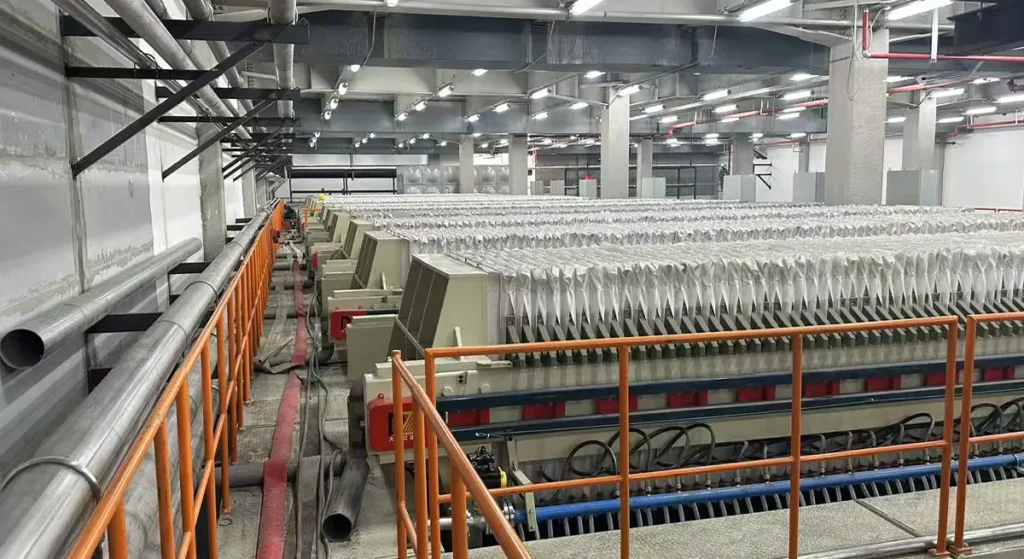
Cloth life varies widely. Abrasive mining slurries and poorly washed municipal cloths can fail in weeks. Stable, well-washed industrial duty can last many months. Automatic water washing filter presses exist because manual wash quality declines across shifts and blinded cloths quietly add an hour to every cycle. Budget cloths as a consumable with a replacement plan, not as a one-time spare.
Disposal is leverage. Every extra point of moisture is water you pay to haul. That is the economic engine behind membrane squeeze and behind insisting on pilot moisture numbers instead of brochure numbers.
Labor shows up as overtime when discharge is sticky, plates leak, or the press must be opened mid-cycle to clear a wet chamber. Plate alignment, gasket condition, and hydraulic holding pressure prevent most leaks. Inadequate maintenance is one of the five root causes that drive most field failures, together with cloth blinding, poor conditioning, pump problems, and misalignment.
Spare-parts lead time belongs in the operating-cost model. A press that waits two weeks for a membrane or a cylinder is more expensive than a slightly higher capital machine supported by stocked wear parts.
When does filter press automation pay for itself?
Automation pays for itself when labor is scarce, cycles must stay consistent across shifts, or the plant runs enough hours that manual plate handling becomes the bottleneck. Program-controlled automatic membrane and chamber filter presses recover the extra investment through repeatable cycle times, fewer cloth injuries, and less missed discharge.
The functions that matter are automatic plate shifting, programmable pressure ramps, squeeze timing on membrane machines, cloth washing, and interlocks that refuse to open under residual pressure. PLC control also creates a record: fill time, peak pressure, filtrate flow decay. That record is how plants catch a sludge change before cake quality collapses.
Automation is not a substitute for sludge control. A fully automatic press fed with unconditioned thin slurry will still produce wet cake—just more consistently wet cake. The return is highest when thickening, polymer, and the press are treated as one system.
Hydraulic chamber filter presses without full plate-shifting automation remain appropriate for lower duty cycles and plants that already staff the dewatering hall. The decision is hours of operation and required consistency, not a rule that every press must be fully automatic.