
A chamber filter press is a batch-type solid-liquid separation machine that uses a series of recessed plates to form fixed-volume chambers. Slurry is pumped into these chambers under pressure; solids are retained by the filter cloth while liquid passes through as filtrate. The result is a compact filter cake that can be discharged once the cycle is complete.
At DZ Environmental we have manufactured program-controlled chamber filter presses for many years. In our project experience, this design remains one of the most widely specified solutions when plants need reliable dewatering performance at a controlled capital cost.
How Does a Chamber Filter Press Work?
The operating cycle follows a clear sequence:
- The hydraulic system closes and locks the plate pack, creating sealed chambers between the recessed plates.
- A feed pump forces slurry into the chambers. Solids begin to accumulate on the filter cloths while filtrate flows out through the drainage channels.
- As the cake builds, resistance increases and filtrate flow slows. The pump continues until the design pressure is reached or filtrate flow drops to a preset minimum.
- The feed is stopped, pressure is released, and the plate pack is opened.
- Cake is discharged—either manually or by automatic plate-shifting mechanisms—and the cloths are cleaned if required before the next cycle.
Because the chambers have a fixed volume, the final cake thickness is determined by the plate design and the amount of solids that can be packed into each chamber under the available pressure.
What Are the Main Components of a Chamber Filter Press?
A typical machine consists of:
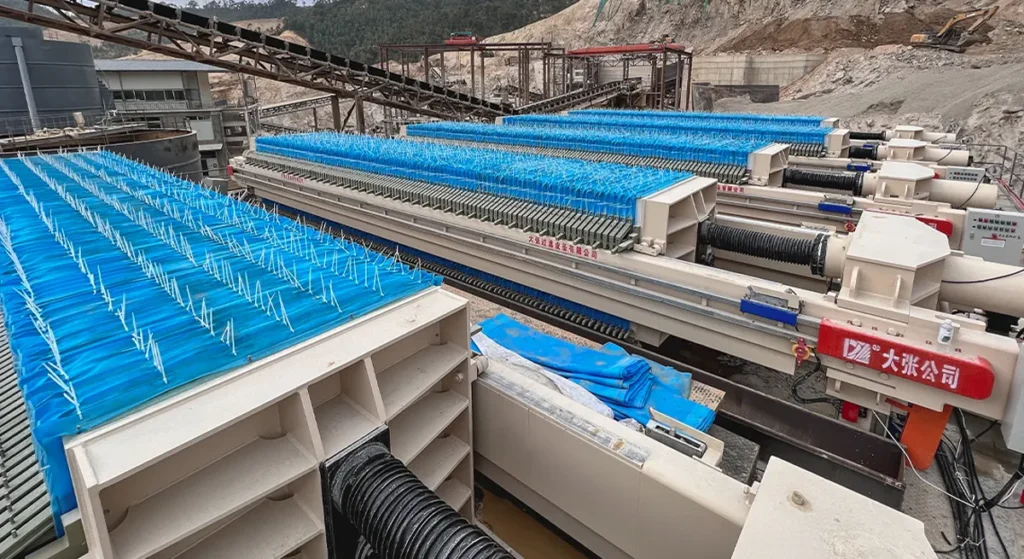
- A sturdy frame (sidebars or overhead beam design) that absorbs the high closing forces
- Recessed filter plates, usually made of reinforced polypropylene
- Filter cloths tailored to the particle size and chemical nature of the slurry
- A hydraulic closing system that generates and maintains the sealing force
- Feed pump, piping and valves
- Optional automation packages: automatic plate shifters, cloth washing systems and PLC controls
In the chamber presses we build, high-precision CNC machining and robotic welding help ensure plate flatness and structural consistency—two factors that directly affect sealing reliability and long-term performance.
Where Is a Chamber Filter Press Commonly Used?
Chamber filter presses are applied across a broad range of industries:
- Municipal and industrial wastewater sludge dewatering
- Mining and mineral processing (concentrate and tailings)
- Chemical and pharmaceutical production
- Food and beverage processing
- Metal finishing and electroplating waste
They perform especially well on slurries that form reasonably permeable cakes and where extreme dryness is not the primary requirement. In many municipal plants, a well-operated chamber press still delivers cake moisture in the 60–70% range, which is sufficient for certain disposal or further treatment routes.
What Are the Advantages and Limitations?
Advantages
- Lower capital cost compared with membrane filter presses
- Mechanically simpler design with fewer wear components
- Proven reliability across decades of industrial use
- Flexible capacity: filtration area can be increased by adding more plates
- Compatible with a wide range of filter cloths and automation levels
Limitations
- Cake moisture is generally higher than that achieved by membrane presses on compressible materials
- Cycle times can be longer because dewatering relies solely on feed-pump pressure
- Performance is more sensitive to incomplete chamber filling or variations in slurry solids content
From the projects we have engineered, the decision often comes down to whether the extra dryness and shorter cycles of a membrane system justify the higher investment. When moderate performance meets process needs, the chamber design continues to offer a cost-effective and robust solution.
Key Factors When Specifying a Chamber Filter Press
Several parameters should be evaluated early:
- Required filtration area and chamber volume based on daily solids load and target cycle time
- Operating pressure rating (commonly 7–15 bar)
- Plate size and material
- Degree of automation (manual, semi-automatic or fully program-controlled)
- Cloth specification matched to particle size distribution and chemical compatibility
- Available space, cake handling method and integration with upstream thickening or downstream disposal
Proper sizing starts with accurate slurry data. In our experience, laboratory or pilot testing on the actual material significantly reduces the risk of undersizing or oversizing the machine.
Frequently Asked Questions
Is a chamber filter press the same as a plate-and-frame filter press?
Not exactly. Traditional plate-and-frame designs use separate plates and frames. Modern chamber (recessed-plate) presses form the chambers directly in the plates, which improves sealing and cake discharge.
What cake moisture can I expect on municipal sludge?
Typical results fall between 60% and 72% moisture, depending on sludge type, conditioning and operating pressure. Achieving consistent results below 60% usually requires optimized polymer dosing or consideration of a membrane press.
How long does a typical cycle take?
Cycle times vary widely with slurry characteristics and machine size, but many industrial applications range from 1 to 4 hours. Automation and good cloth maintenance help keep cycles consistent.
Can chamber filter presses be fully automated?
Yes. Program-controlled versions with automatic plate shifting, cloth washing and PLC supervision are standard offerings. These features reduce labor requirements and improve operating consistency.
How does maintenance compare with a membrane filter press?
Chamber presses have fewer components subject to fatigue (no membranes or squeeze circuits), so routine maintenance is generally simpler. Cloth condition and hydraulic system integrity remain the primary focus.