
Choosing between a chamber filter press and a membrane filter press is one of the most common decisions plant engineers and procurement teams face when specifying solid-liquid separation equipment. Both technologies are widely used, both can handle municipal sludge, mining tailings, chemical slurries and industrial wastewater, yet they differ significantly in cake dryness, cycle time, capital cost and long-term operating economics.
At DZ Environmental we manufacture both program-controlled chamber filter presses and automatic membrane filter presses, so the comparison below is based on real engineering data and project experience rather than a preference for one product line over the other.
What Is the Fundamental Difference Between the Two Designs?
A chamber (recessed plate) filter press forms fixed-volume chambers between recessed plates. Slurry is pumped in under pressure; solids build up as a cake while filtrate passes through the cloth. Once the chambers are full and filtrate flow drops, the cycle ends. Dewatering relies entirely on the feed pump pressure.
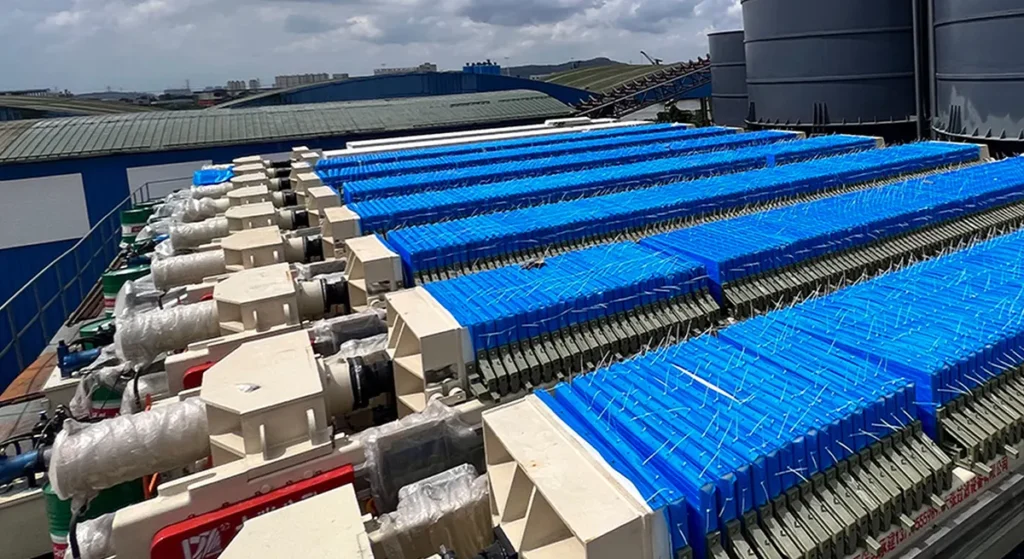
A membrane filter press looks similar but uses plates that incorporate flexible membranes (usually polypropylene or elastomer). After the initial filtration phase, a fluid—most commonly water or air—is introduced behind the membranes. The membranes inflate and mechanically squeeze the cake, expelling additional liquid. This secondary squeeze is the single most important performance differentiator.
How Do Cake Moisture and Cycle Time Compare?
| Performance Metric | Chamber Filter Press | Membrane Filter Press |
|---|---|---|
| Typical cake moisture (municipal sludge) | 60–72% | 50–62% (often 55% or lower) |
| Moisture reduction vs chamber | Baseline | 5–12 percentage points lower |
| Typical cycle time | Longer | Often 20–40% shorter |
| Sensitivity to incomplete fill | Higher | Lower (squeeze compensates) |
| Cake uniformity | Good | Excellent |
The membrane squeeze applies a more uniform and higher effective pressure (commonly 12–16 bar) directly to the cake after filtration. This is especially valuable for compressible municipal and biological sludges that tend to seal under pure pump pressure.
Capital Cost vs Operating Cost: Where Does the Money Really Go?
Chamber filter presses generally have a lower purchase price. For plants that only need moderate cake dryness or process relatively easy-to-dewater materials, this can be the more economical choice.
Membrane filter presses carry a higher initial investment because of the more complex plates and the additional squeeze system. However, the drier cake frequently reduces downstream costs—hauling, landfill tipping fees, or further thermal drying—enough to offset the capital premium within a few years. Shorter cycle times also mean higher throughput from the same footprint, which improves the return on the larger machine.
In projects we have supported, the payback period for upgrading from chamber to membrane technology is often driven more by disposal cost savings than by the equipment price difference itself.
Which Applications Favor Each Type?
Chamber filter presses perform well when:
- Cake moisture targets are not extremely stringent
- Slurry is relatively easy to dewater
- Capital budget is constrained
- The process involves frequent changes in plate configuration or requires simpler maintenance
Membrane filter presses are usually preferred when:
- Lowest possible cake moisture is a priority (municipal sludge, high-disposal-cost waste)
- Cycle time and plant throughput matter
- Sludge characteristics vary and process flexibility is needed
- Downstream processes benefit from drier, more handleable cake
Many municipal plants that previously operated chamber presses have moved to membrane units once disposal costs or regulatory pressure increased. Conversely, some chemical and food-processing applications continue to use chamber presses successfully because the incremental dryness of a membrane system is not required.
Other Practical Differences Worth Considering
- Automation and control
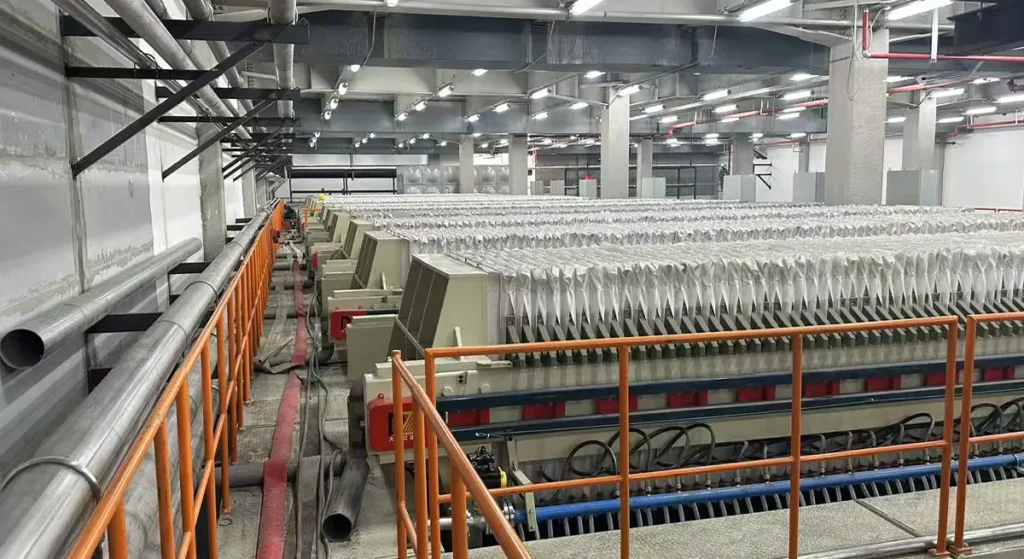
Both designs can be fully automated with PLC systems, automatic plate shifting and cloth washing. The membrane version simply adds control logic for the squeeze phase. Our program-controlled machines integrate these functions so operators can set pressure profiles, squeeze times and safety interlocks from a single interface. - Maintenance
Membrane plates introduce additional components (membranes and squeeze circuits). Modern designs have significantly improved membrane life, but plants should still plan for periodic inspection. Chamber plates remain mechanically simpler. - Cloth selection and cake release
Membrane presses often achieve better cake release because the squeeze creates a denser, less sticky cake. Cloth choice still matters for both technologies; the wrong micron rating or surface finish can undermine the performance of either machine.
How Should You Decide?
Start with three questions:
- What cake moisture (or dry solids) do you actually need to meet disposal, transport or process requirements?
- How variable is your slurry, and how important is cycle-time consistency?
- What is the true cost of residual water in your cake over a 5–10 year horizon?
When these answers point clearly toward lower moisture or higher throughput, a membrane filter press is usually the stronger technical and economic choice. When moderate performance is sufficient and capital is tight, a well-designed chamber press remains a reliable solution.
Because we manufacture both types on the same high-precision production lines—using CNC machining, robotic welding and rigorous factory testing—we can size and configure either technology to match specific sludge characteristics, capacity targets and automation preferences. Many clients begin with laboratory or pilot testing so the recommendation is based on their actual material rather than generic assumptions.
Frequently Asked Questions
Can a chamber filter press ever match the dryness of a membrane unit?
On some incompressible materials, the difference is small. On typical municipal or biological sludge, the membrane squeeze consistently produces drier cake.
Is the membrane system much more complicated to operate?
With modern PLC controls the additional steps are automated. Operators mainly monitor the same parameters they would on a chamber press, plus the squeeze pressure and duration.
How long do membranes typically last?
Service life depends on the slurry chemistry, operating pressure and number of cycles. In properly designed systems, membranes often last several years before replacement is required.
Do you need higher feed pressure for a membrane press?
Not necessarily. The primary filtration pressure can be similar to a chamber press; the extra dryness comes from the subsequent membrane squeeze.
Is it possible to convert a chamber press to membrane later?
In most cases it is more practical and cost-effective to install a purpose-built membrane machine rather than attempt a retrofit.